



Log in

You are here

Action Oak

The Action Oak partnership was launched at this year’s Chelsea Flower Show in London last May

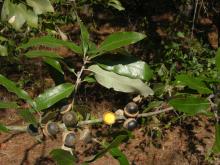
In October 2017, I visited Palomar Mountain State Park, San Diego County, California to collect acorns of the interior live oak, Quercus wislizeni (Section Lobatae), for an investigation of oak hybridization at that location. Following the first day on site, while reviewing the day’s leaf samples, acorns, and photographs, a chance photo with an oblique view suggested that one individual Q. wislizeni bore yellow or golden hairs on the abaxial leaf surface.

Oak Genome Reveals Facets of Long Lifespan

New research published in Nature Plants provides insights into why oaks are long lived. 

North America is home to 91 species of oak trees. Astoundingly, the various species rarely, if ever, occur alone. Where one kind of oak is found, invariably at least one more will be found. How can nature support a setup like that when it operates on the principle that only the fittest survive in any one setting?

Illinois State Museum features dwarf chinkapin oak, discovered in Illinois during an IOS Tour, as part of the Illinois Bicentennial exhibition.

Plant pathologists from the California Department of Agriculture (CDFA) recently identified a new species of fungal pathogen that infects oak, chinkapins, and tanoaks. Until recently, North American diagnosticians called all species of the genus Tubakia that infects oaks in North America, Tubakia dryina, because they all have very similar morphological features to this European fungus. However, a new study shows that the North American species vary genetically from Tubakia dryina. Among these is the newly recognized California species.

A Monument to Monumental Oaks

Rainer Lippert has always been interested in old trees. At the age of 16 he started to visit the largest trees in his home district in Germany, drawn in particular to the majestic grandeur of ancient oaks. He recorded their dimensions, categorizing the giants according to the girth of their trunks. As he grew older, his range of action became wider, expanding from rural district to administrative region, then his entire native Bundesland (as German states are called), and ultimately all of Germany.

Pages

Editor's Picks

Past IOS President Allen Coombes, Curator of Scientific Collections at Puebla University Botanic Garden, discusses leaf variability in Quercus ceirpes (still image from the documentary)
A new documentary by Maricela Rodríguez Acosta
Website Editor | Feb 17, 2026
Quercus miyagii acorn and dried leaves
A rare oak endemic to the Ryukyu Islands of Japan
Elion Jam | Feb 16, 2026
A moss-covered oak (Quercus orocantabrica) in Mata de Albergaria, Peneda-Gerês National Park, Portugal  © Amit Zoran
Steve Potter reviews a new book that features oaks
Steve Potter | Feb 11, 2026

Plant Focus

Quercus canariensis in Cornwall Park, Epsom, Auckland, New Zealand, the champion specimen in New Zealand, planted in the 1920s, 27.2 m tall with a trunk diameter of 209 cm (G. Collett pers. comm. 2026)  © Gerald Collett
Antonio Lambe shares his views on this threatened oak native to Iberia and North Africa

Dendrology

Action Oak

The Action Oak partnership was launched at this year’s Chelsea Flower Show in London last May

In October 2017, I visited Palomar Mountain State Park, San Diego County, California to collect acorns of the interior live oak, Quercus wislizeni (Section Lobatae), for an investigation of oak hybridization at that location. Following the first day on site, while reviewing the day’s leaf samples, acorns, and photographs, a chance photo with an oblique view suggested that one individual Q. wislizeni bore yellow or golden hairs on the abaxial leaf surface.

Oak Genome Reveals Facets of Long Lifespan

New research published in Nature Plants provides insights into why oaks are long lived. 

North America is home to 91 species of oak trees. Astoundingly, the various species rarely, if ever, occur alone. Where one kind of oak is found, invariably at least one more will be found. How can nature support a setup like that when it operates on the principle that only the fittest survive in any one setting?

Illinois State Museum features dwarf chinkapin oak, discovered in Illinois during an IOS Tour, as part of the Illinois Bicentennial exhibition.

Plant pathologists from the California Department of Agriculture (CDFA) recently identified a new species of fungal pathogen that infects oak, chinkapins, and tanoaks. Until recently, North American diagnosticians called all species of the genus Tubakia that infects oaks in North America, Tubakia dryina, because they all have very similar morphological features to this European fungus. However, a new study shows that the North American species vary genetically from Tubakia dryina. Among these is the newly recognized California species.

A Monument to Monumental Oaks

Rainer Lippert has always been interested in old trees. At the age of 16 he started to visit the largest trees in his home district in Germany, drawn in particular to the majestic grandeur of ancient oaks. He recorded their dimensions, categorizing the giants according to the girth of their trunks. As he grew older, his range of action became wider, expanding from rural district to administrative region, then his entire native Bundesland (as German states are called), and ultimately all of Germany.

Pages

The International Oak Society acknowledges the generous support of the following institutions:

Supporting Institutional Members

 

Standard Institutional Members

Rice University
San Diego Botanic Garden logo
San Diego Zoo Wildlife Alliance logo
South Carolina Botanical Garden


The Huntington
The John Fairey Garden